About
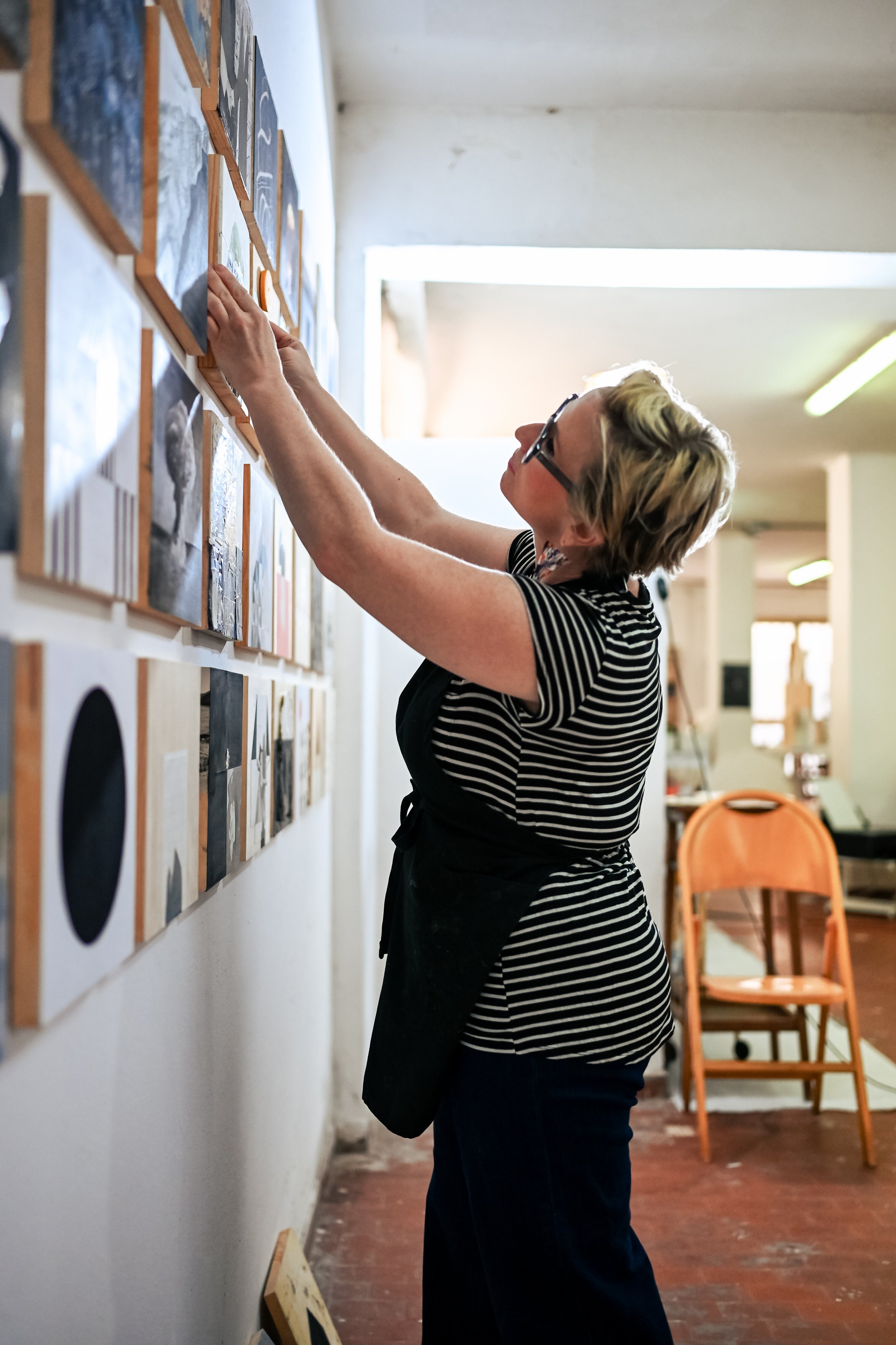
Rebecca Olsen is an American multi-media artist based in Florence, Italy; born in Florence, Italy, to American artist parents and raised in San Antonio, Texas; she has lived and worked in Italy since 1998. Her practice spans printmaking, painting, drawing, sculpture, photography, installation, and video; exploring the intersections between perception, infinity, and the nature of reality. Her work merges material experimentation with philosophical inquiry; balancing structure and uncertainty to examine how knowledge and meaning are constructed—and where they begin to dissolve. As she has said, “I like to make things with my hands,” yet her work extends beyond craft into epistemological exploration; what she calls thinking through making. Olsen is President and CEO, and Co-founder of SRISA – Santa Reparata International School of Art; she has curated or co-curated nearly forty exhibitions at the SRISA Gallery. She is represented by Whitegrid Gallery in Berlin and exhibits internationally across Europe, the United States, and Asia.
“Her work can be described as a Gnostic exercise fueled by a profound urge to understand the world; one that includes aspects of neuroscience, the physics of wave motion, the effects of climate change, and the urban systems of the 20th century. Olsen asserts that her research is driven by two opposing forces; curiosity and the desire for knowledge, countered by the certainty that knowledge is often beyond reach.”
— Pietro Gaglianò, 2024

Artist Statement
If I had to make one statement that remains true, it would be this: She likes to make things with her hands.
That feels both true and incomplete. My practice is rooted in material engagement; making with my hands, thinking with my mind, and exploring how the two inform one another.
I describe my process as unfettered play; a space of experimentation that allows mistakes and discovery. An educator’s job is to give students the capacity to ask the right questions. This idea extends into my art; each work begins with inquiry rather than intent, emerging through process.
It’s about resisting; oppressors, language, rules. It’s about tension; the anxiety of uncertainty, the knowledge of impermanence, the vastness of infinity. It’s beautiful, but it’s not about beauty; until it is. It’s not political until it has to be, which now it does.
It’s about making things with my hands, and thinking things with my brain, and it’s also about the brain itself. My work is visually rooted in a solid formal language that is intuitive; like an algorithm running beneath the surface of everything I do; providing a balanced structure and point of view that allows me to expand and contract, to hunt and gather from many mediums.
My work cannot be defined by any one style or medium, but by a method; a process; a signature. Each medium gives me new tools to express my intellectual and visual ideas in different ways.
My work engages with epistemology, ontology, infinity, and the structures of power; resisting simplicity and existing in the tension between order and chaos, permanence and change. Through layering of imagery, surface, texture, and meaning; I build systems that both create and collapse coherence, echoing the unstable architectures of thought.
My visual language is formal yet intuitive; guided by rhythm, contradiction, and repetition. Over time, my intellectual and creative pursuits have merged; the work itself has become both the question and the research; a way to approach what cannot be fully known.
Art, like all human invention, is a fiction; but one made real through the hand. If intellect gives art its direction, the hand gives it truth.